One-Sided Love vs Mutual Love (Test Guide)
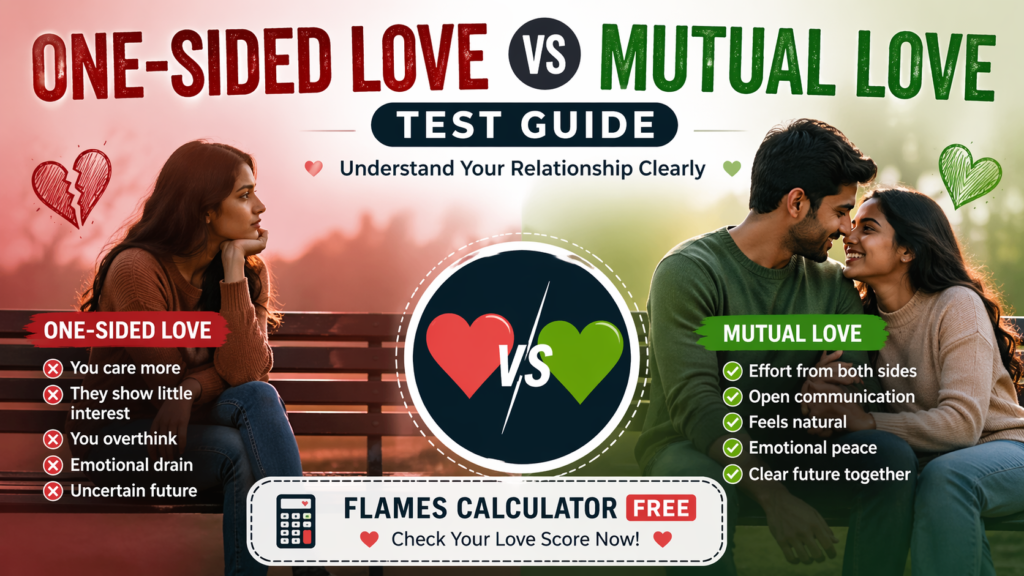
Love can feel magical—but it can also be confusing, especially when you’re unsure whether your feelings are shared. Many people find themselves stuck between hope and reality, wondering: Is this love one-sided, or are we both feeling it?
This complete guide will help you understand the difference between one-sided love vs mutual love, along with a simple “test” approach you can use to evaluate your situation. If you’ve ever felt emotionally invested in someone who gives mixed signals, this article is for you.
What Is One-Sided Love?
One-sided love happens when only one person has deep romantic feelings, while the other person either doesn’t feel the same way or isn’t emotionally invested.
It often starts with strong attraction, frequent thoughts about the person, and emotional attachment—but without equal effort or affection in return.
Common Signs of One-Sided Love
- You are always the one initiating conversations
- Replies from them feel delayed, short, or uninterested
- They rarely make time for you
- You overthink their actions and messages
- You feel emotionally drained instead of happy
In one-sided love, you give more than you receive, which can slowly affect your self-worth and confidence.
What Is Mutual Love?
Mutual love is when both people share feelings, effort, and emotional investment equally. It feels balanced, natural, and secure.
There’s no guessing game—you both show interest openly and consistently.
Signs of Mutual Love
- Both of you initiate conversations and plans
- Communication feels effortless and enjoyable
- You feel valued, respected, and understood
- Effort comes from both sides naturally
- There is emotional safety and trust
In mutual love, you don’t constantly question your importance—you feel it clearly through actions.
One-Sided Love vs Mutual Love: Key Differences
Understanding the contrast makes it easier to identify where you stand.
1. Effort
- One-sided love: Effort comes mostly from you
- Mutual love: Both people contribute equally
2. Communication
- One-sided: Inconsistent, confusing, or forced
- Mutual: Smooth, engaging, and natural
3. Emotional Experience
- One-sided: Anxiety, overthinking, doubt
- Mutual: Comfort, happiness, and clarity
4. Time Investment
- One-sided: They are “too busy” for you
- Mutual: They make time for you
5. Future Intentions
- One-sided: Unclear or avoided
- Mutual: Open and discussed
The Simple “Love Test” Guide
If you’re unsure where your relationship stands, use this practical test. It’s not about guessing—it’s about observing real behavior.
Step 1: Stop Initiating for a Few Days
Take a step back and see what happens.
- Do they reach out to you?
- Do they notice your absence?
Result:
- If they don’t contact you → likely one-sided
- If they check in → sign of mutual interest
Step 2: Observe Their Effort
Ask yourself:
- Do they make plans with you?
- Do they remember small details about you?
- Do they show genuine interest in your life?
Result:
- Low effort = one-sided love
- Consistent effort = mutual love
Step 3: Pay Attention to Communication Quality
It’s not just about how often you talk—but how you talk.
- Are conversations meaningful or dry?
- Do they ask questions about you?
- Do they engage or just reply?
Result:
- Surface-level chats = one-sided
- Deep, engaging talks = mutual
Step 4: Emotional Check-In
After interacting with them, ask yourself:
- Do I feel happy or drained?
- Do I feel secure or anxious?
Result:
- Drained and confused = one-sided love
- Happy and calm = mutual love
Step 5: Future Signals
Notice how they talk about the future.
- Do they include you in plans?
- Do they avoid serious topics?
Result:
- Avoidance = one-sided
- Inclusion = mutual
Why One-Sided Love Feels So Strong
One-sided love can feel intense because it often involves:
- Imagination and “what if” scenarios
- Emotional attachment without closure
- Hope that things might change
Your brain keeps searching for small signs and overvalues them. This creates a cycle of hope → doubt → overthinking → emotional exhaustion.
How to Handle One-Sided Love
If your “test” suggests that your feelings aren’t being returned, it’s important to respond wisely.
1. Accept the Reality
It’s difficult, but clarity is better than confusion. Acceptance helps you move forward.
2. Stop Over-Investing
Pull back your time and emotional energy. Focus on yourself.
3. Avoid Chasing
If someone is interested, they won’t make you chase constantly.
4. Build Self-Worth
Remember: love should feel mutual, not one-sided. You deserve equal effort.
5. Move On Gradually
You don’t need to rush—but you do need to detach over time.
How to Strengthen Mutual Love
If your feelings are mutual, that’s a great sign—but maintaining it matters too.
1. Communicate Openly
Share your thoughts and feelings honestly.
2. Appreciate Each Other
Small gestures and gratitude go a long way.
3. Maintain Balance
Avoid taking each other for granted.
4. Build Trust
Consistency creates emotional security.
5. Grow Together
Support each other’s goals and dreams.
Can One-Sided Love Become Mutual?
Sometimes—but not always.
It may turn mutual if:
- The other person wasn’t aware of your feelings
- Timing was off
- They develop feelings over time
However, you should never wait indefinitely hoping someone will change. Real love doesn’t require constant waiting or convincing.
Quick Self-Assessment Checklist
Answer these honestly:
- Do they initiate contact without you?
- Do they make time for you?
- Do you feel secure instead of anxious?
- Do they show consistent effort?
Results:
- Mostly “No” → One-sided love
- Mostly “Yes” → Mutual love
Final Thoughts
Understanding the difference between one-sided love and mutual love can save you from emotional confusion and heartbreak.
Love should not feel like a constant struggle for attention or validation. The right connection will feel balanced, natural, and reassuring—not exhausting.
If you’re unsure about your situation, use this guide as a reality check. And if you want a fun and quick way to explore your connection, try using a FLAMES Calculator to get a playful perspective on your relationship.
FAQs
Is one-sided love real love?
Yes, your feelings are real—but love becomes complete only when it’s mutual.
Why does mutual love feel easier?
Because effort, emotions, and communication flow equally from both sides.
Should I confess in one-sided love?
You can, but be prepared for any outcome. Clarity is better than uncertainty.
How long should I wait for someone?
Not too long—if there’s no effort from their side, it’s best to move on.
Conclusion:
Love is not about chasing—it’s about connection. If it’s mutual, you’ll feel it without confusion. If it’s one-sided, you’ll constantly question it. Choose clarity, choose balance, and most importantly—choose yourself.
Read Also
- How Accurate Is a Crush Calculator
- How to Know If Your Crush Likes You
- Love Compatibility Test – Full Explanation
- Does Name Spelling Affect FLAMES Result?
- Is FLAMES Game Scientific? Truth Revealed
- FLAMES Game Ideas for School & College Fun
- Relationship Prediction Games Like FLAMES
- 100+ Funny FLAMES Game Questions
- FLAMES Calculator FAQs – All Questions Answered
- Compatibility Test by Name – Does It Work